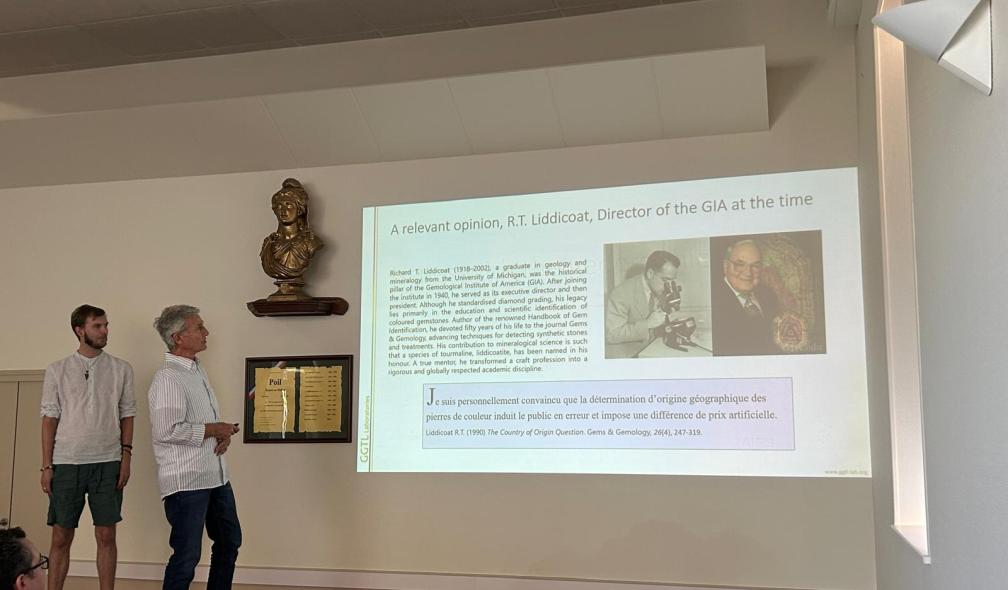
Franck Notari and Féodor Blumentritt present a conference: Issues with the geographical origin, Poil d'été 2026
The world is vast, gems are small.
That was the opening line — almost a motto — of Franck Notari and Féodor Blumentritt's talk at the recent gemology gathering in Poil, devoted to one of the trickiest subjects in the trade: determining the geographic origin of coloured gemstones, illustrated through the emblematic case of Kashmir sapphire.
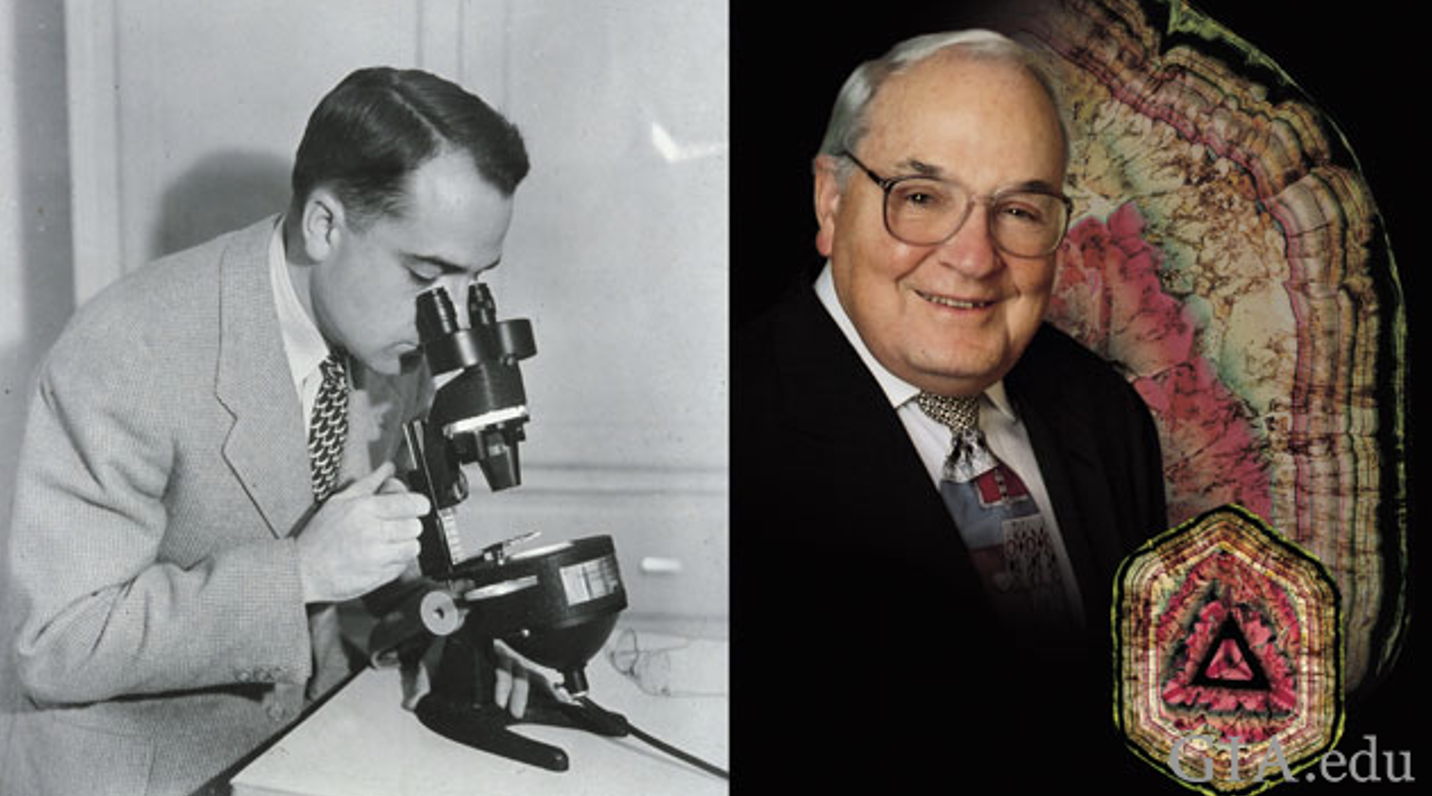
The starting premise is almost provocative, coming as it does from within the discipline itself. Richard T. Liddicoat, the historic pillar of the GIA, wrote back in 1990 that he was personally convinced that determining the geographic origin of coloured stones misleads the public and imposes an artificial price differential — a rare admission from a man who spent fifty years building gemology into a rigorous science.
And for good reason: two sapphires born thousands of kilometres apart — Kashmir, Mogok, Pailin, Andranondambo, Buttala, Elahera — can share almost everything. Similar chemistry, near-identical UV-Vis-NIR spectra, comparable inclusions, the same colour. Nature doesn't sort its crystals by country; it distributes them along statistical curves that overlap considerably. The 14,000 samples collected in the field at Soomjam in 1986 tell the story less of an identity than of a population, with all the variability that implies, from deposit to individual sample, treatment included.
So how is it done? By cross-referencing: microscopic observation, inclusion structure, chemical composition, colour — a multi-analysis approach that can, at best, suggest a probable origin, never an absolute certainty.
What remains is the market's dilemma, which Franck and Féodor left hanging at the end of their talk, quoting S. F. McClure, T. M. Moses and J. E. Shigley (2019): the ship has already sailed. Too many stones have been sold on the basis of their origin for the industry to turn back now. The system has taken hold, whether or not the science fully agrees.
GGTL Laboratories keeps walking that tightrope: staying rigorously honest about science's limits, while answering to a market demand that shows no sign of retreating.