Batavian tears: a gemmological look at glass under extreme tension
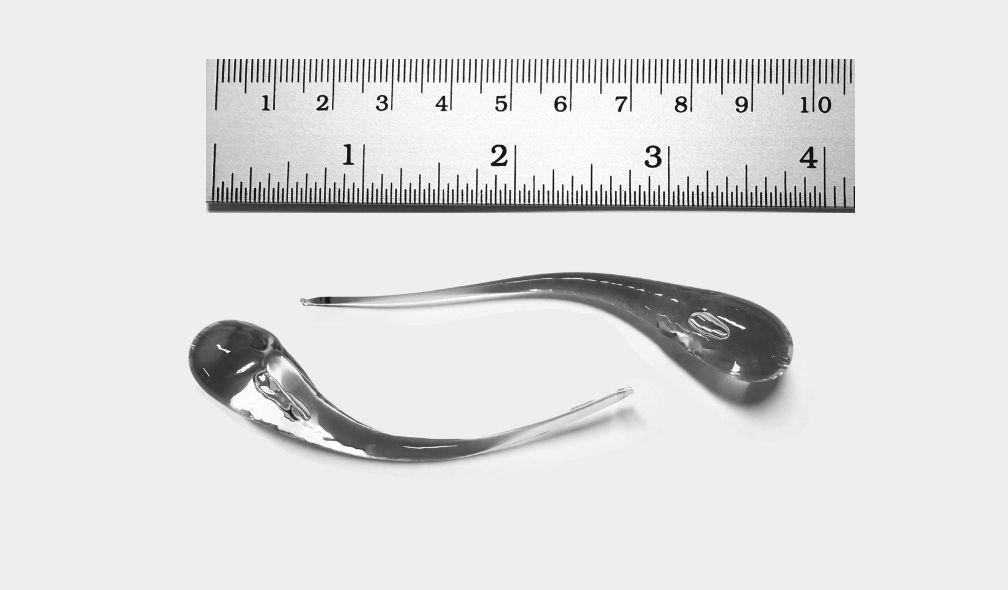
Cover Image: The photo shows two tears, ref. SGDF-18387 a & b.
Why not talk about glass?
It's a subject that also interests gemmologists.
Today, I would like to show you some extraordinary objects known as ‘Batavian tears’.
These tears are produced by dropping a drop of molten glass into cold water. This causes the surface to cool extremely quickly and solidify, creating an outer layer under compression formed of SiO2 molecules stationary/locked in a very dense, disorganised structure, creating a rigid shell.
While the still-liquid core contracts as it cools more slowly, and since the surface is already rigid, this contraction exerts a tension force on the surface, inducing very high stresses.
This effect of quenching with opposing bidirectional tensions makes the ‘head’ very difficult to break.
Aben et al. (2016) were able to demonstrate that it could withstand a pressure of 15,000 newtons, or 1,500 kilogram-force (kgf), between two tungsten carbide plates without breaking.
This exceptional resistance can be explained by tension constraints reaching 400 to 700 MPa on the surface (measured by integrated photoelasticimetry).
However, the tip of the tear is the area where the tension constraints are most concentrated.
If it breaks, the internal constraints are suddenly relaxed, and the stored energy is released throughout the entire mass of the tear at an extraordinarily fast speed, causing a catastrophic fracture (explosion into micro-fragments).
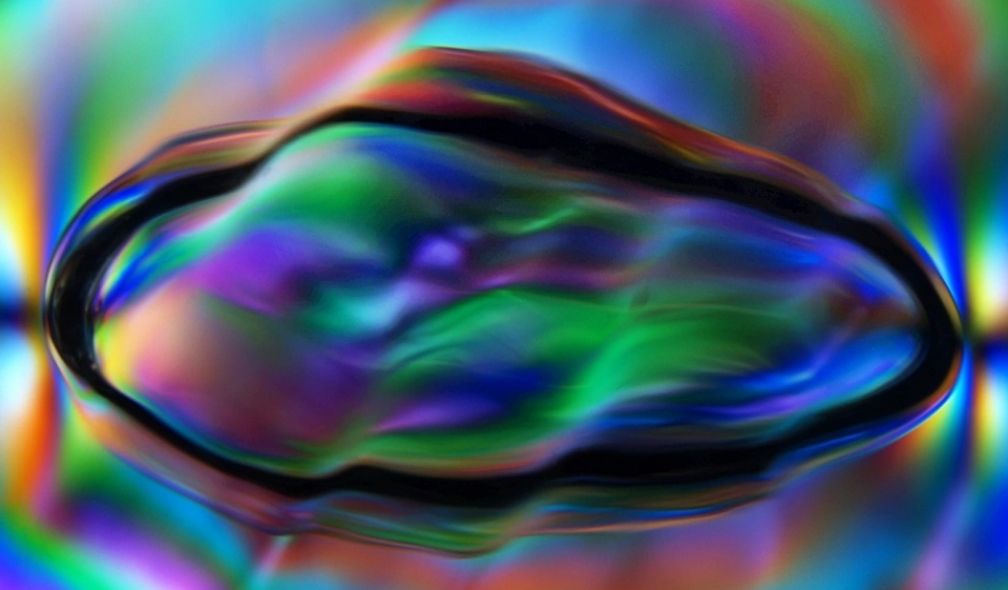
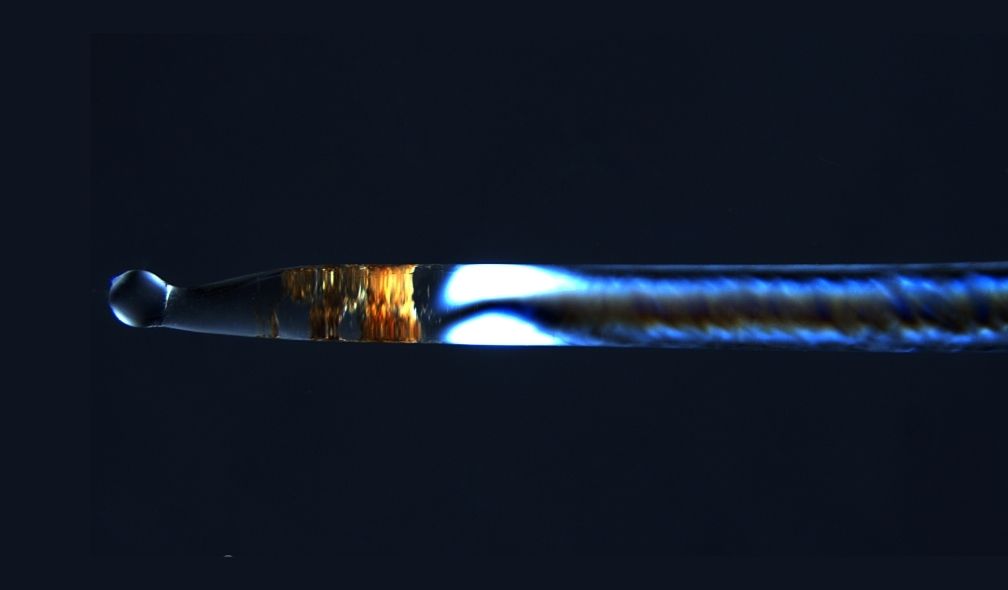
The micrographs were collected using a Leica M205C microscope equipped with a Leica DMC5400 camera in z-stack mode.
- Photo and micrographs by F. Notari, 2025.